The way people search online is changing.
People still use Google. They still compare businesses, read reviews, scan websites, and look for proof that a company knows what it’s doing. But the path from search to decision is getting less straightforward. Instead of clicking through several pages to piece together an answer, people are increasingly seeing AI-generated summaries, asking full questions, and using tools like Google AI Overviews, ChatGPT, Gemini, and Perplexity to get faster direction.
That shift is where Answer Engine Optimization comes in.
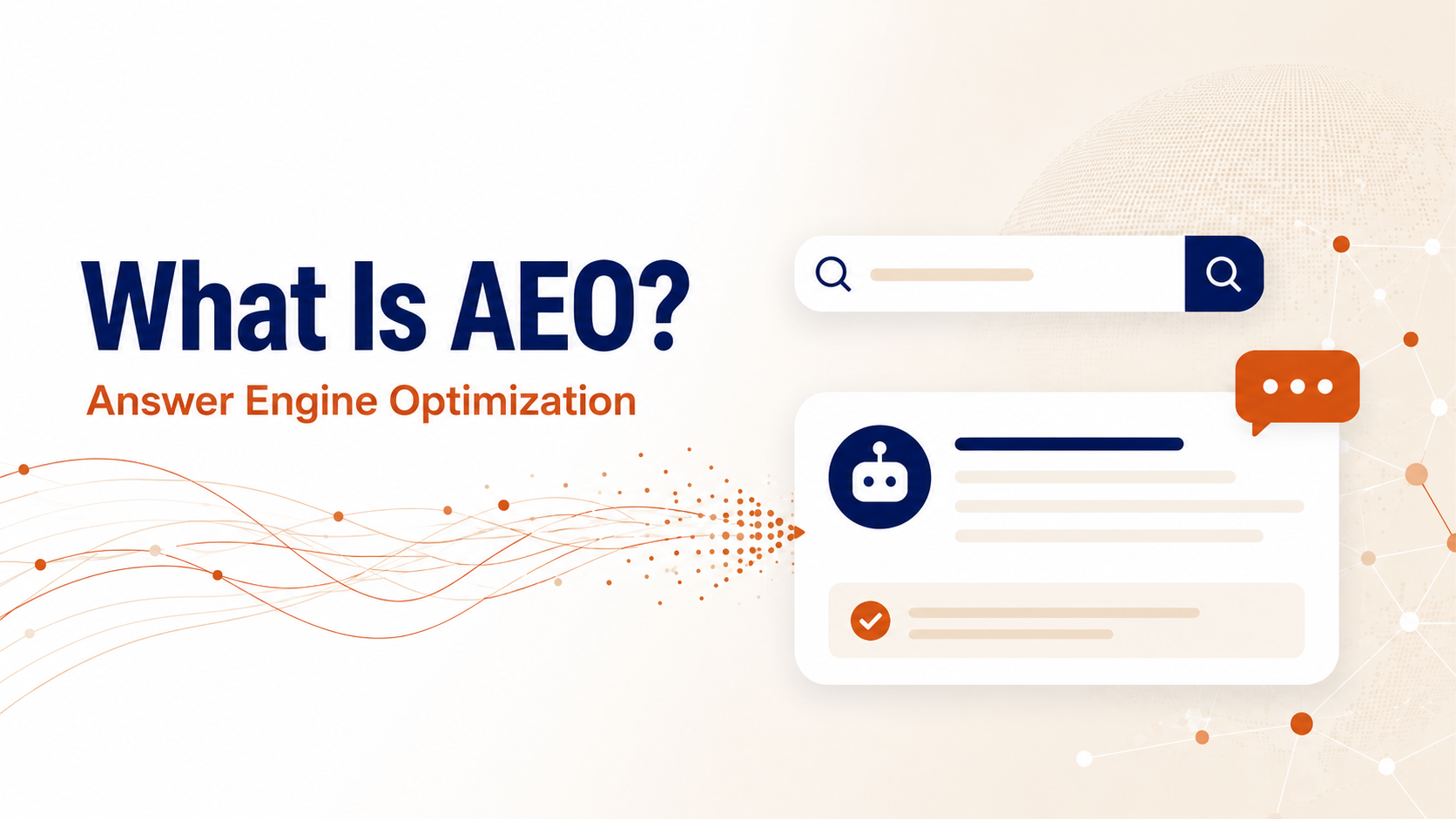
Answer Engine Optimization, often shortened to AEO, is the process of making your website content easier for search engines and AI-powered answer tools to find, understand, trust, and potentially use in generated responses. It does not replace SEO. It builds on it. Strong SEO is still the foundation, but the way people discover information is changing, and businesses need to pay attention to more than rankings alone.
Key Takeaways
- AEO is part of SEO, not a replacement for it. Strong technical SEO, clear content, and trustworthy website information still create the foundation.
- AI search is changing how people find answers. Users are asking longer, more specific questions and often getting summaries before they click through to a website.
- Your website content needs to be clear and useful. Answer engines rely on content they can understand, summarize, and connect to user intent.
- Local businesses should pay attention. Service pages, location pages, reviews, and consistent business information can all influence how a company is understood online.
- There is no quick Answer Engine Optimization hack. The work comes down to strong SEO, helpful content, clear structure, and real expertise.
What Is Answer Engine Optimization?
Answer Engine Optimization is about helping your content become part of the answer.
Traditional search has usually focused on ranking a webpage in search results. A user types a phrase, reviews the results, clicks a link, and lands on a website. That still happens, and it still matters.
Answer Engine Optimization adds another layer. It focuses on how your content may appear, be cited, or be summarized in answer-based search experiences. These experiences are designed to respond more directly to user questions instead of only showing a list of links.
That could include:
- A Google AI Overview that summarizes information at the top of a search result
- An AI assistant that recommends a business or explains a service
- A voice search result that answers a question out loud
- A chatbot-style search tool that pulls details from multiple sources
The goal is not to “game” AI. That rarely holds up for long. The goal is to make your content clear, useful, specific, and credible enough that search systems can understand what you do and why it matters.
Why Answer Engine Optimization Is Getting More Attention
AEO is getting more attention because search behaviour is changing.
People are asking longer, more specific questions. They are comparing options earlier. They are looking for quick explanations before they decide who to contact. A search that used to be “SEO company Barrie” might now look more like, “What should I look for in a digital marketing agency for a local service business?”
That kind of query needs more than a keyword match. It needs context.
AI-generated answers are also changing how much information people can see before they click through to a website. A potential customer may get a summary, shortlist, recommendation, or explanation directly in the search experience. That means your business can make an impression earlier in the decision-making process, even before someone lands on your site.
That does not mean websites no longer matter. It means the job of a website is expanding. Your content may influence how your business is summarized, compared, or understood inside an AI-generated answer.
AEO Is Part Of SEO, Not A Replacement For It
One of the biggest misconceptions about AEO is that it replaces SEO. It doesn’t.
Answer Engine Optimization is not a separate magic trick. It is not a workaround for poor content, a weak website, or technical issues that prevent search engines from understanding your pages. SEO is still the foundation.
Google’s own guidance says SEO best practices continue to be relevant for generative AI search because AI features in Google Search are rooted in its core ranking and quality systems. Google also explains that AEO and GEO are industry terms, but from Google Search’s perspective, optimizing for generative AI search is still part of optimizing for the search experience.
In practical terms, that means the basics still carry weight:
- Your website needs to be crawlable.
- Your pages need to load properly.
- Your content needs to answer the topic clearly.
- Your site structure needs to make sense.
- Your business information needs to be accurate.
- Your content should show real expertise, not just repeat what every competitor says.
Answer Engine Optimization sits on top of that work. It asks a slightly different question: is this page helpful enough, clear enough, and trustworthy enough to be used as part of an answer?
How AI Search Is Changing The Customer Journey
The customer journey used to be easier to map. Someone searched, clicked, read, compared, and contacted.
Now, more of that research can happen before the website visit. A potential customer may ask an AI tool for a shortlist, a comparison, a definition, a price range, or a recommendation. They may come to your website later in the process, already carrying an impression of your business.
That impression may come from your website, your Google Business Profile, reviews, directory listings, social content, third-party mentions, or a mix of all of them.
For businesses, this creates a new visibility challenge. It’s no longer enough to have a service page that says, “We offer digital marketing services.” The page needs to explain what that means, who it helps, what problems it solves, and what makes the approach credible.
Specificity matters more than ever.
A generic page gives AI systems very little to work with. A useful page gives them context.
What Type Of Content Supports AEO?
The best content for AEO usually starts with the questions real people are already asking.
These questions will look different depending on the business, industry, and audience. For example, a digital marketing company might include questions like:
- How do I know if my website needs SEO?
- Why is my website traffic dropping?
- What is the difference between SEO and paid ads?
- How long does digital marketing take to work?
- What should a service-area page include?
- How do AI Overviews affect website traffic?
A local service business, manufacturer, healthcare provider, professional office, or e-commerce company will have a different set of questions. The principle stays the same: strong content answers what a potential customer wants to understand before they are ready to call, book, buy, or request a quote.
That content may include service pages, blog posts, FAQs, comparison content, industry pages, location pages, and educational guides. The format matters less than the usefulness of the information.
Good content for answer engines usually has a few things in common:
- It answers the main question directly.
- It uses clear headings that match what the reader wants to understand.
- It explains terms instead of assuming everyone knows them.
- It includes details that are specific to the business, industry, or location.
- It avoids vague claims that could apply to any company.
- It helps the reader make a more informed decision.
Google’s guidance also emphasizes creating unique, valuable, people-first content rather than recycling what already exists online. It specifically notes that content based on first-hand experience or a unique point of view can be more useful than generic summaries.
That is good news for businesses with actual expertise. The work is not about saying more. It is about saying something more useful.
How To Start Building AEO Into Your Strategy
AEO works best when it is built into your existing SEO strategy, not treated like a separate checklist. The goal is to make your website easier for people, search engines, and AI-powered tools to understand.
That starts with the basics: strong service pages, clear content, technical SEO, helpful structure, and accurate business information. None of those are new ideas. They just matter more when search experiences are becoming more answer-driven.
Start With Your Audience’s Real Questions
Good AEO starts with what your audience actually wants to know.
Look at the questions that come up in sales calls, contact form submissions, emails, reviews, and client meetings. What do people ask before they are ready to buy, book, or request a quote? What do they misunderstand? What do they compare? What makes them hesitate?
Those questions can guide stronger website content. Instead of building pages around keywords alone, build content around the information people need to make a decision.
Strengthen Your Core Service Pages
Your main service pages should clearly explain what you offer, who the service is for, what problems it solves, and what someone should do next.
If those pages are thin, unclear, or too similar to other pages on your site, they are usually the first place to improve. A strong service page gives readers better information and gives search systems more context about your business.
This is also where specificity matters. A page that says “we offer digital marketing services” does not say much. A page that explains your approach, your services, your process, your audience, and the problems you help solve is much more useful.
Improve The Structure Of Your Content
Clear structure helps people scan your content and understand it faster. It also helps search engines and AI-powered tools follow how ideas connect.
Use headings that clearly explain what each section covers. Add lists where they make the information easier to digest. Define industry terms when needed. Keep each section focused on one main idea.
The goal is not to over-format every page. The goal is to make the content easier to follow.
Make Sure The Technical Foundation Holds
AEO cannot do much if the website itself is difficult to crawl, slow to load, poorly organized, or missing important page information.
Technical SEO still matters. Your site structure, metadata, page speed, crawlability, mobile experience, internal linking, and structured data all play a role in how easily search systems can access and understand your content.
This matters for Answer Engine Optimization because answer engines rely on information they can access and understand. If your content is helpful but your website is slow, messy, or difficult to crawl, it becomes harder for that content to support your search visibility.
Build Trust Across Your Online Presence
Answer engines don’t look at your website in isolation. Your business may also be understood through reviews, your Google Business Profile, directory listings, social profiles, case studies, third-party mentions, and other public information.
That means consistency matters. Your services, location details, contact information, business descriptions, and areas served should align across the web.
Trust signals also help. Reviews, case studies, credentials, team expertise, useful examples, and clear business information all give people and search systems a more complete picture of who you are and what you offer.
Keep Improving As Search Changes
Answer Engine Optimization is not a one-time update. Search behaviour will keep shifting, and your content should keep up.
Review your most important pages regularly. Update outdated information. Add answers to new customer questions. Improve pages that are too vague. Watch how people are finding you, what they are asking, and where your content could do a better job.
The businesses that do this well are not chasing every new search trend. They are building a stronger, clearer, more useful digital presence that can hold up as search continues to change.
Why Local Businesses Should Pay Attention
Answer Engine Optimization isn’t only a concern for national brands or large publishers. Local businesses should be watching this closely too.
Many local searches are already conversational. People are not only searching for “hearing clinic near me” or “paper shredding company.” They are asking things like:
- Who offers mobile shredding for medical offices?
- What should I ask before choosing a hearing clinic?
- Which local company can help redesign my website and improve SEO?
- How do I know if a storage unit is right for business inventory?
These questions are specific. They often include service intent, local intent, and decision-making intent all at once.
That is where well-built local content can help. Service-area pages, location pages, industry pages, and locally relevant blog posts can give search systems clearer information about what a business does, where it works, and who it serves.
The old approach of copying the same page and swapping out the city name will not do much here. Thin local content is easy to spot and rarely helpful. A better page explains the service in a way that fits the location, the customer, and the real reason someone is searching.
Common Answer Engine Optimization Mistakes To Avoid
The biggest mistake is treating Answer Engine Optimization like a hack.
Creating a few generic FAQs, adding “AI” to a title, or stuffing long-tail keywords into a page will not build lasting visibility. It may make the page worse for the person reading it, which defeats the point.
Another mistake is writing only for AI. People still make the decision. They still judge whether your business sounds credible, whether your website feels current, and whether your content answers their actual concern.
There is also a lot of noise around technical shortcuts. Google says website owners don’t need special machine-readable files, AI text files, or new markup to appear in Google Search’s generative AI features. Google also says there is no need to rewrite content in a special way just for AI systems.
That doesn’t mean businesses should ignore the shift. It means they should focus on the work that holds up: strong SEO, useful content, clear structure, accurate information, and real expertise.
Final Thoughts
AEO is not the end of SEO. It is one more reason SEO needs to be done well.
Search is becoming more answer-driven, more conversational, and more influenced by AI-generated summaries. That changes how people discover businesses. It also changes what strong content needs to do. A website can no longer rely on surface-level service pages or generic blog content and expect to be clearly understood.
The stronger approach is to build content that answers real questions, explains services clearly, and gives search systems the right context to work with. That means strengthening your SEO foundation, improving your core pages, creating useful content, and making sure your business information is accurate across your online presence.
For businesses, Answer Engine Optimization is not about chasing a new trend. It is about staying visible as search changes.
Netgain helps businesses build SEO and content strategies that support how people search now, from traditional results to answer-driven search. That includes strengthening service pages, creating useful blog content, improving technical SEO, and making sure your website gives search engines and potential customers the right information to work with.
If your website content is not keeping up with the way search is changing, let’s talk.
FAQs About Answer Engine Optimization
How Often Should Website Content Be Updated For AEO?
There is no fixed schedule, but important service pages and high-performing blog posts should be reviewed regularly. Update content when services change, customer questions shift, search results change, or the page no longer reflects how your business actually works.
Can Paid Ads Help With AEO?
Paid ads can support visibility, traffic, and lead generation, but they do not directly optimize your website for organic AI-generated answers. A strong strategy can include both paid and organic work, but it’s tied more closely to content quality, SEO, authority, and how clearly your business is represented online.
Should Businesses Use AI Tools To Write AEO Content?
AI tools can help with research, outlines, and early drafts, but the final content still needs human expertise. The strongest content includes real experience, specific details, and judgment. That is the part generic AI-generated content usually misses.
Is AEO Only Important For Blog Posts?
No. Blog posts can support it, but your core website pages matter just as much. Service pages, location pages, industry pages, case studies, FAQs, and your overall site structure all help search systems understand your business.
What Is The First Thing A Business Should Do For Answer Engine Optimization?
Start by improving your most important service pages. Make sure they clearly explain what you offer, who you help, where you work, and what questions customers usually ask before they contact you. A clear service page is often more valuable than publishing another generic blog post.